The Ultimate Guide to ACMV Ducting Work & Ventilation Efficiency in Singapore
The Ultimate Guide to ACMV Ducting Work & Ventilation Efficiency in Singapore
Proper Air-Conditioning and Mechanical Ventilation (ACMV) ducting systems are the backbone of indoor thermal comfort, indoor air quality (IAQ), and energy efficiency across Singapore’s commercial buildings, industrial facilities, and residential complexes. Operating in a high-humidity tropical climate, improper duct sizing, poor thermal insulation, or air leakage can rapidly lead to excessive energy bills, mold accumulation, and uneven cooling performance.
This guide breaks down essential ACMV ducting considerations, ductwork materials, diagnostic methods, and how precision fabrication ensures long-term operational performance.
Understanding ACMV Ducting Systems in Singapore Properties
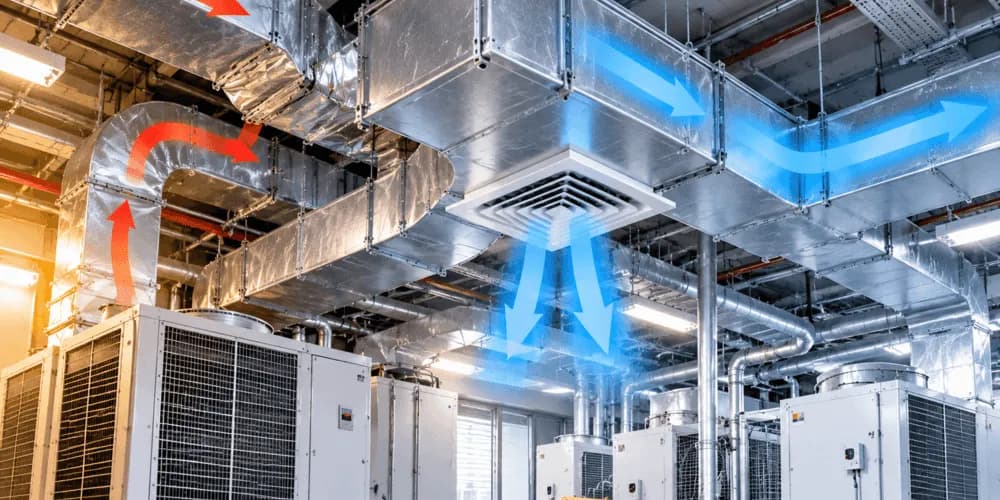
Air ducts distribute conditioned cool air, fresh outdoor air, and exhaust stale air throughout a building envelope. In Singapore, ACMV systems must strictly comply with Singapore Standard SS 553 (Code of Practice for Air-Conditioning and Mechanical Ventilation in Buildings) and SCDF Fire Safety Codes.
Common issues resulting from faulty or aging ACMV ductwork include:
- Duct Sweating & Condensation: High ambient humidity hitting uninsulated or poorly sealed cold air ducts causes condensation droplets, leading to ceiling water stains and microbial growth.
- Airflow Pressure Loss & Hot Spots: Leakage along duct flange joints or improper duct sizing reduces static pressure, leaving distant rooms or upper floors poorly cooled.
- Excessive Acoustic Noise & Vibration: Unbalanced air velocity or inadequate sound attenuators create annoying humming and airflow turbulence in offices and residential spaces.
- Grease & Odor Accumulation: In commercial kitchen exhaust systems, unsealed duct joints accumulate heavy grease, posing serious fire hazards and violating environmental health codes.
Essential Ducting Fabrication Materials & Techniques
Selecting the right duct material and insulation is critical for thermal retention and longevity:
1. Galvanized Iron (GI) Sheet Ducting
GI ductwork is the industry standard for general supply, return, and fresh air systems. Manufactured in various sheet gauges according to SMACNA standards, GI ducts offer high structural rigidity and economic durability.
2. Stainless Steel Ducting (Grade 304 / 316)
Stainless steel ducting is essential for heavy-duty commercial kitchen exhaust systems, laboratory fume extraction, and corrosive industrial environments due to its high heat resistance and rustproof properties.
3. Pre-Insulated Ducting Systems
Constructed from high-density rigid polyisocyanurate (PIR) or polyurethane foam cores faced with aluminum foil, pre-insulated ducting offers superior thermal performance, lightweight construction, and rapid installation for space-constrained sites.
4. Thermal & Acoustic Duct Insulation
High-density closed-cell elastomeric rubber insulation or aluminum-faced glass wool wrapping is applied around supply air ducts to prevent surface temperature drops below the dew point, eliminating sweating.
Air Balancing & System Commissioning
Fabrication and installation are only half the battle. Professional Testing, Adjusting, and Balancing (TAB) is essential after fitting:
- Static Pressure & Velocity Checks: Measuring airflow (CFM) at air grilles using anemometers to balance air volume per zone.
- Damper Calibration: Adjusting volume control dampers (VCD) and fire dampers (FD) to achieve engineered airflow profiles.
- Duct Leakage Testing: Applying pressure testing procedures to verify airtightness along all longitudinal and transverse seams.
Why Choose Legacy Engineering Services Pte Ltd?
- bizSAFE Star & SS 553 Compliant: Operations adhere strictly to local safety, fire, and engineering codes.
- Precision Workshop Fabrication: In-house sheet metal cutting and fabrication ensure exact spatial fitting with minimal site delay.
- In-House Engineering Team: Multi-disciplinary oversight ensuring seamless integration with electrical and civil trade works.
- Turnkey Testing & Commissioning: Complete air balancing and certification handover for hassle-free building sign-offs.
Conclusion
Optimizing your ACMV ductwork system enhances indoor air quality, lowers monthly utility bills, and prevents costly structural water damage caused by duct condensation. For expert ACMV ducting fabrication, installation, or system upgrades, contact Legacy Engineering Services Pte Ltd today.